
The 2026 Atlantic Hurricane Season Is Quiet So Far: What Does This Mean?
Published:
Just how quiet is the 2026 season?
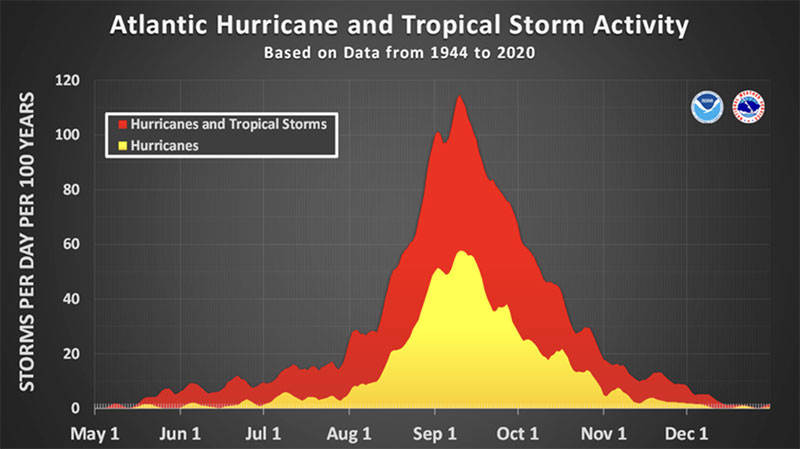
Since June 1st, the beginning of Atlantic hurricane season, no hurricanes have formed in the Atlantic basin. Forecasters predicted a below normal season due to the onset of El Niño conditions as hurricane season approached, but activity has been below what forecasters originally predicted. Typically, the first hurricane of the season occurs in early to mid-August, however, the peak of hurricane season passed on September 10, and the Atlantic has yet to see a hurricane form.
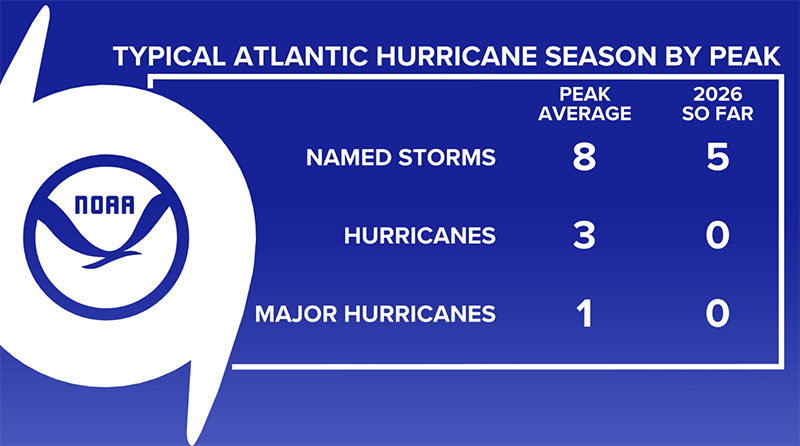
By this time in the season, the Atlantic has normally seen an average of 8 named storms, 3 hurricanes, and 1 major hurricane [1]. So far this season, there have been 8 named systems and 0 hurricanes. Previously, the latest first hurricane of the season formed on September 11, 2002 (Hurricane Gustav), but this season has that record beat, making it the longest stretch the Atlantic has gone without a hurricane since the earliest records of modern-day storm tracking dating back to 1966. There have only ever been two years with no recorded hurricanes at all. Those years were 1907 and 1914, but ocean monitoring was not fully complete- meaning the ocean was essentially a low-data zone before satellites, ocean data sensors, or any technology with the ability to consistently and thoroughly gather data from over the ocean. Since a hurricane could have easily been missed due to the lack of information over the ocean, meteorologists do not fully trust the completeness records [2].
Why is this season so quiet?
El Niño has been a strong influence on our unusually quiet season so far. El Niño typically increases wind shear in the Atlantic, and this year, above average wind shear has been observed in key areas of the Atlantic where hurricanes tend to form. Since July, wind shear has been recorded as the strongest on record since 1979, when wind shear records began [10]. This season’s higher wind shear, in combination with dry air and Saharan dust over the Atlantic has made conditions hostile for tropical cyclone formation. Ocean temperatures have been record hot for 100 days, which normally would increase tropical activity as warm water fuels tropical cyclones and allows systems to strengthen. However, high sea surface temperatures are not the only ingredients required for tropical cyclone formation - atmospheric moisture, instability, and low wind shear are also required, and so far this season, those other ingredients have been lacking.
How does this season compare to other quiet seasons?
As mentioned earlier, the previous record for the latest first hurricane of the season was set in 2002. The 2002 season also had below average hurricane activity, but in addition, a large number of weak subtropical storms were recorded [4]. Not only did the 2002 season start late, with the first hurricane not forming until September 11th, but it was short-lived with no named storms forming in October or November. September was a very active month with eight named storms forming throughout the month, setting a record for September.
Similar to this year, ENSO records suggest an early onset of El Nino conditions as the 2002 hurricane season approached [5]. Due to El Nino increasing wind shear in the Atlantic, and therefore decreasing tropical activity, the similarities between the quiet 2002 season and this year’s season are no surprise. However, El Niño conditions are not a requirement for a quiet or late-onset season. This was demonstrated in 2013 when the first hurricane of the season (Hurricane Humberto) formed on September 11th, tying the record for the latest first hurricane of the season. During this time, ENSO conditions were neutral, meaning average ocean temperatures and typical trade winds [6]. The same can be said for the 2001 hurricane season which also had a late start with the first hurricane (Hurricane Erin) forming on September 8 [7].
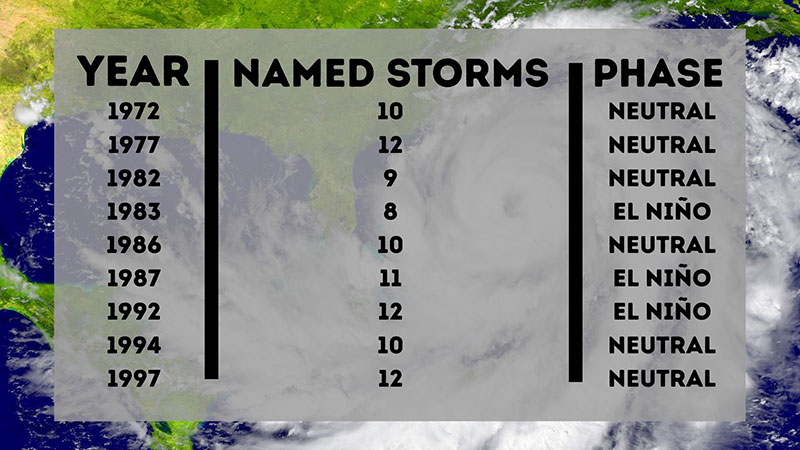
I took note of several other years (since 1966) that had below average activity during the Atlantic season (12 or less named storms throughout the season). I found that every one of the years were in El Niño or the neutral phase. Below is a chart of years with notably less activity (figure 3).
So what does this mean for the rest of the season?
Though things are quiet in the Atlantic right now, hurricane season is far from over and does not end until November 30th. As El Niño continues to strengthen and enhance wind shear over the tropical Atlantic, the chance of having a hurricane-free Atlantic season remains a possibility. However, as the adage goes: it only takes one storm to turn a quiet season into a severe one. Very warm waters and low wind shear over the gulf may provide an environment conducive for tropical development later in the season.
- “2026 Atlantic hurricane season breaks 60-year record”
- “Atlantic sets no-hurricane record; Gulf development zone watched”
- “Where have all the Atlantic hurricanes gone? El Nino might bring record slow storm season”
- “Summary of 2002 Atlantic Tropical Cyclone Season and Verification of Authors’ Seasonal Forecasts
- “El Niño/Southern Oscillation (ENSO) Diagnostic Discussion 2002”
- “El Niño/Southern Oscillation (ENSO) Diagnostic Discussion 2013”
- “El Niño/Southern Oscillation (ENSO) Diagnostic Discussion 2001”
- “Atlantic Storm Totals Table”
- “ENSO Past Events”
- “Blame Super El Niño For This Strange Hurricane Season”

